
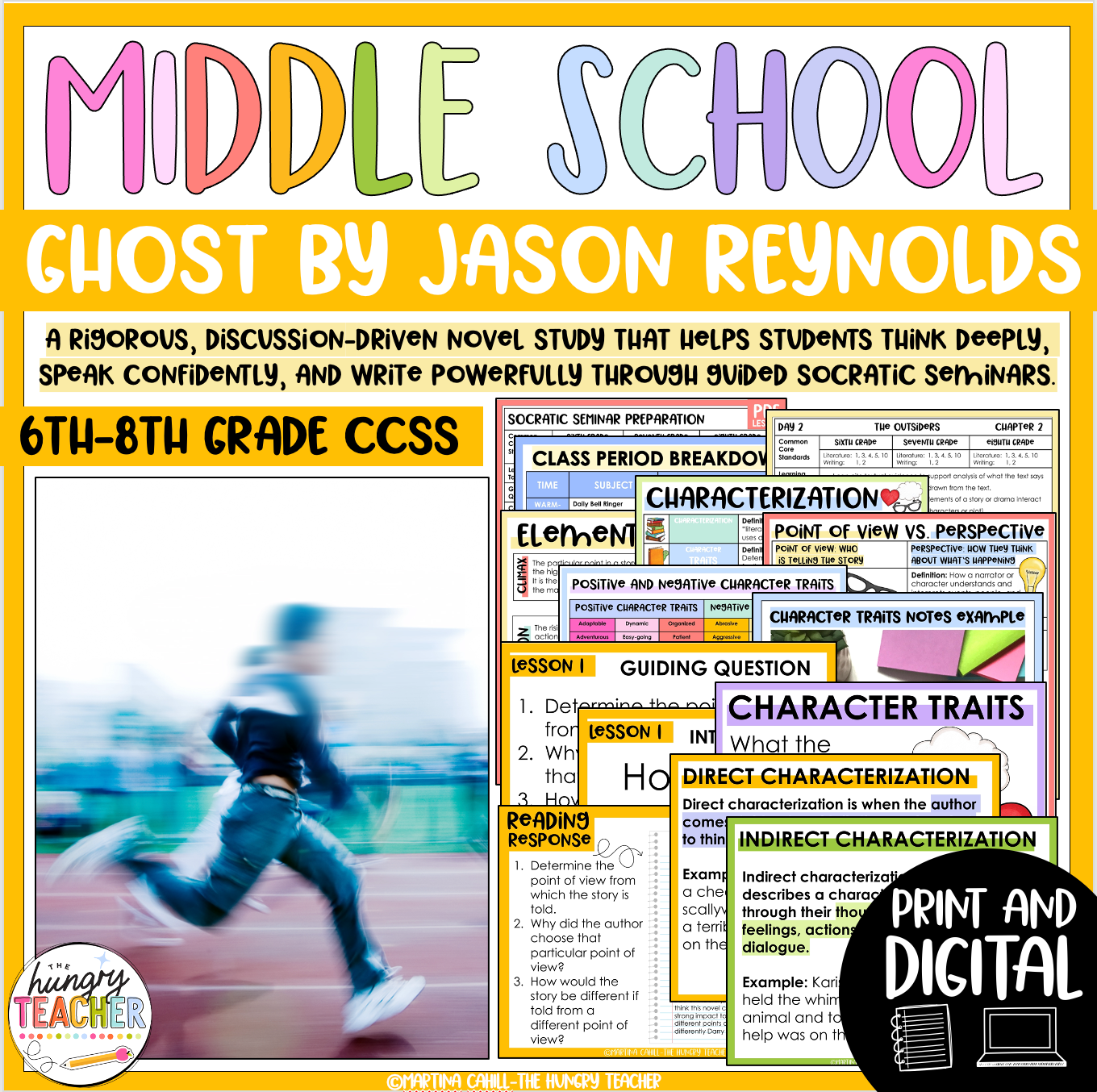
Ghost by Jason Reynolds
Teaching literature concepts and literary devices through Ghost by Jason Reynolds will be engaging, thought-provoking, and thorough with this Socratic Seminar and literary devices novel study. This complete Ghost reading unit helps your students actually think, discuss, and write about the novel while you teach sixth, seventh, and eighth-grade reading literature and writing standards.

This middle school ELA novel study is built around a simple, repeatable structure: read → write → discuss → revise. Students read Ghost with a clear purpose, respond to guiding questions, take their thinking into structured Socratic Seminar discussions, and then return to their writing to revise and strengthen their ideas.
This middle school ELA novel study is built around a simple, repeatable structure: read → write → discuss → revise. Students read Ghost with a clear purpose, respond to guiding questions, take their thinking into structured Socratic Seminar discussions, and then return to their writing to revise and strengthen their ideas.
Instead of spending the entire novel answering question after question about what happened, students use the events of Ghost to dig into point of view, author’s purpose, central idea, conflict, theme, literary imagery, character traits, characterization, inferences, author’s craft, mood and tone, symbolism, plot, and more.
What makes this unit different:
- Instead of assigning dozens of comprehension questions as the main event, students focus on strong guiding and interpretive questions that give them something meaningful to think, write, and talk about.
- Students don’t write a response and immediately move on. They have opportunities to discuss their ideas with classmates and then return to their writing to make it stronger.
- You’re not just “getting through Ghost.” You’re using a novel students can get invested in to teach them how to analyze literature, support their thinking with evidence, discuss complex ideas, and write stronger responses.
- The same read → write → discuss → revise structure repeats throughout the unit, so students know what to expect without every chapter turning into another packet.
- You still have comprehension questions, suggested answers, and vocabulary when you need them, without making basic comprehension the focus of every class period.
What’s included:
- 18 complete Ghost lessons + a final project
- Structured, step-by-step lesson plans with standards, learning targets, preparation, pacing, guiding questions, interpretive questions, and teaching support
- Ready-to-teach lesson slides for every lesson and the final project
- Guiding questions that give students a purpose for reading and writing
- Interpretive questions designed for deeper analysis and Socratic Seminar discussion
- Example reading responses so you can actually show students what strong thinking and writing can look like
- Comprehension questions + suggested answer keys
- Vocabulary suggestions connected to the novel
- Digital + printable student notebooks and response materials
- Literature reference pages + interactive notebook lessons for the concepts taught throughout the unit
- Reading response graphic organizers
- Editable, differentiated reading response rubrics for 6th, 7th, and 8th grade
- Full Socratic Seminar implementation support with norms, pacing, examples, and classroom routines
- Small-group and individual conference forms
- Sixth–eighth grade CCSS alignment built directly into the unit
- Print + digital formats for flexible classroom use
The unit is intentionally designed so the literature instruction, discussion, and writing work together. Students first build the background knowledge they need for the literary concept, read with a guiding question in mind, write about their thinking, discuss a deeper interpretive question with their peers, and then use what came out of that conversation to revise or extend their writing.
The 19 lessons are:
- Pre-Lesson: Socratic Seminar Norms
- Ghost Day 1, Chapter 1: Point of View
- Ghost Day 2, Chapters 2–3: Author’s Purpose
- Ghost Day 3, Chapters 4–5: Central Idea
- Ghost Day 4, Chapter 6: Conflict
- Ghost Day 5, Chapter 7: Theme
- Ghost Day 6, Chapters 8–9: Literary Imagery
- Ghost Day 7, Chapters 10–11: Character Traits
- Ghost Day 8, Chapters 12–13: Characterization
- Ghost Day 9, Chapters 14–15: Point of View vs. Perspective
- Ghost Day 10, Chapters 16–17: Inferences
- Ghost Day 11, Chapters 18–19: Author’s Craft
- Ghost Day 12, Chapter 20: Mood and Tone
- Ghost Day 13, Chapter 21: Symbolism
- Ghost Day 14, Chapter 22: Narrative Point of View
- Ghost Day 15, Chapter 23: Plot
- Ghost Day 16: Comparing Texts
- Ghost Day 17: Comparing the Print + Audio Versions
- Ghost Day 18: Objective Summaries
- Final Project
Those lesson topics and chapter ranges are pulled directly from the newly updated unit.
Throughout the unit, students are repeatedly citing textual evidence, analyzing author choices, discussing interpretations, and using those conversations to improve their written responses. The standards are mapped by lesson for 6th, 7th, and 8th grade, so you can see exactly where each reading literature skill is being taught and practiced.
Students also get plenty of support without turning the novel into busywork. The included examples give you something concrete to model, the reference pages give students somewhere to go when they need help, and the consistent discussion routine gives them a chance to hear other interpretations before they are expected to strengthen their own writing.
Prep is quick and easy. Review the lesson plan, pull up the ready-to-teach slides, and print or assign the student materials you want to use. The teaching sequence, questions, examples, reference materials, and response support are already built for you.
There is no fluff and no busywork in my reading units. The goal isn’t to prove that students read every chapter. It’s to use a novel they actually want to talk about to help them become stronger readers, writers, and thinkers.