
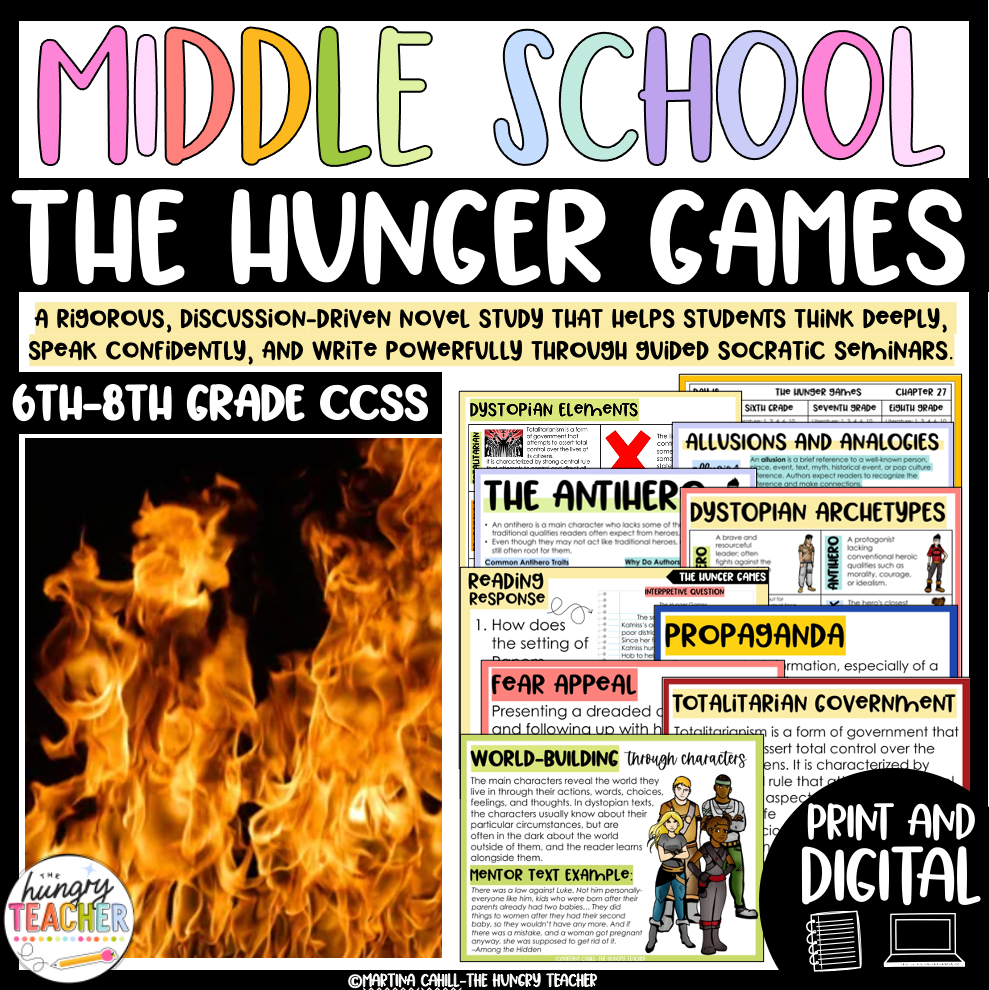
The Hunger Games by Suzanne Collins

This middle school ELA unit is built around a simple, repeatable structure: build or review background knowledge → read → write → discuss → revise.
Students use guiding and interpretive questions to prepare their thinking, participate in structured discussions, and then turn those ideas into stronger written responses.
What makes this unit different:
- Instead of assigning dozens of comprehension questions, students focus on one strong question at a time—which leads to better discussions, stronger writing, and deeper understanding.
- You’re not just “getting through the novel.” You’re teaching students how to think about literature.
What’s included:
- 23 structured, step-by-step lesson plans with pacing and teaching support
- Ready-to-teach slides for every lesson (no extra prep)
- Guiding + interpretive discussion questions that build deeper thinking
- Digital + print student notebooks and reading response pages
- Reading response organizers and examples to model strong analytical writing
- Literary analysis reference pages and mini anchor charts
- Editable, differentiated reading response rubrics (multiple grade levels)
- Full Socratic Seminar implementation guide with norms, pacing, examples, and troubleshooting
- Conference forms and anecdotal notes for small group + individual support
- Final project choice board with creative and analytical project options
- Print + digital formats for flexible classroom use
Students build their understanding through discussion, and that growth shows up in their writing in a major way. This unit covers sixth, seventh, and eighth-grade CCSS literature standards in an engaging, structured format—without adding more work to your plate.
The 23 lesson plans are:
- Pre-Lesson: Socratic Seminar Norms
- The Hunger Games Day 1: Point of View
- The Hunger Games Day 2: Dystopian Elements
- The Hunger Games Day 3: Dystopian World Building
- The Hunger Games Day 4: Propaganda
- The Hunger Games Day 5: Character Traits
- The Hunger Games Day 6: Theme
- The Hunger Games Day 7: Central Idea
- The Hunger Games Day 8: Author’s Craft
- The Hunger Games Day 9: Flashbacks and Flashforwards
- The Hunger Games Day 10: Symbolism
- The Hunger Games Day 11: Author’s Purpose
- The Hunger Games Day 12: Literary Imagery
- The Hunger Games Day 13: Mood and Tone
- The Hunger Games Day 14: Literary Conflict
- The Hunger Games Day 15: Allusions and Analogies
- The Hunger Games Day 16: The Antihero
- The Hunger Games Day 17: Dystopian Archetypes
- The Hunger Games Day 18: Suspense, Foreshadowing, and Cliffhangers
- The Hunger Games Day 19: Narrative Point of View Writing
- The Hunger Games Day 20: Movie Comparison
- The Hunger Games Day 21: Comparing Texts
- The Hunger Games Day 22: Objective Summaries
- The Hunger Games Day 23: The Hunger Games Final Project
In this unit, students participate in meaningful discussions, strengthen their analytical writing, engage with complex dystopian literature, and build confidence expressing their thinking with evidence. At the same time, you still have flexibility to support students at different reading levels and discussion abilities.
Prep is quick and manageable. Simply review the guiding questions, print or display the reference materials, and you’re ready for an engaging, discussion-driven class period. There’s no fluff, busywork, or random packets in this unit—just meaningful reading, writing, and discussion that helps students think more deeply about literature.
TEACHERS LIKE YOU SAID…
⭐️⭐️⭐️⭐️⭐️ Amy S. says, "OBSESSED!!!! I am teaching summer school and I'm normally a math teacher but I am also teaching them ELA. I found this and I honestly wish I taught ELA so I could buy the rest of the novel studies and do them! This is the way you should teach ELA. Easily able to teach all standards through reading notebook, vocabulary, discussion. Lesson plans are soooo thorough. I highly suggest all upper elementary ELA teachers look into your resources!"
⭐️⭐️⭐️⭐️⭐️ Sarah V. says, "I really appreciate how this unit is organized and how thought provoking it has been. We are only a few days in and the students are loving the socratic seminar setup and I, being a newbie with this type of discussion setup, am enjoying all of the instructions and lack of busywork for students to just get done. I'll be purchasing more for the novels that I teach!
⭐️⭐️⭐️⭐️⭐️ Krista L. says, "Students are thrilled to be talking about the book instead of doing a ton of comprehension questions. My students’ writing improved because they are hyper focused on answering the discussion question and are actually using textual evidence to answer, because instead of 5-10 questions, they have one. The vocabulary and extra comprehension questions are very useful as well.