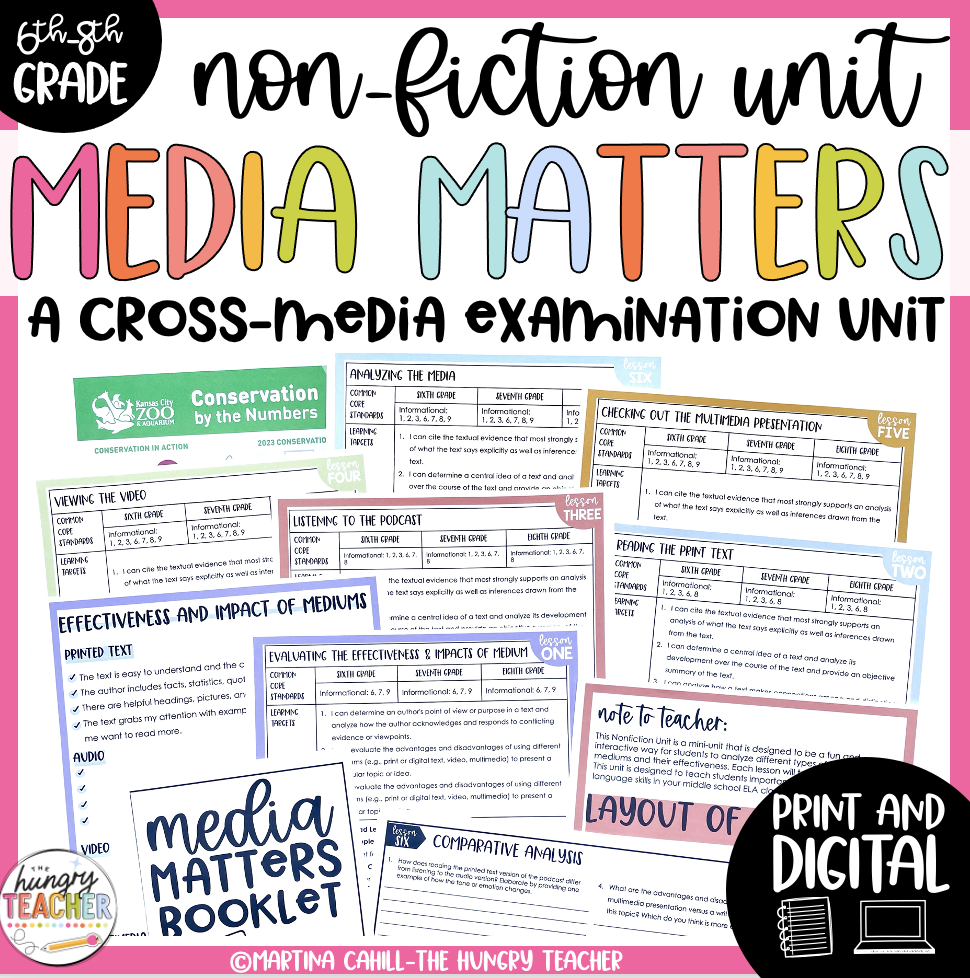

Media Matters Mini-Unit
Build savvy, critical media consumers with Media Matters—a mini-unit for grades 6–8. Students analyze how information is conveyed across print, audio, video, and multimedia, evaluate effectiveness and impact, and synthesize comparisons using a structured student booklet. Low-prep slides, reference tools, and assessments make it easy to teach—while keeping engagement high.

✅ What’s Included:
- Six Scaffolded Lessons: Step-by-step lessons that build students' ability to explore media in all its forms.
-
Teaching Slides: Ready-to-use Google Slides and PDFs that model analysis across media and guide each lesson.
-
Student Booklet: Printable/digital pages for note-taking, checklists, organizer charts, and compare/contrast tasks.
-
Evaluation Checklists & Criteria: Co-create with students or use the included teacher versions for reliability and bias, purpose, audience, tone, evidence, and technique.
-
Reference Guides: Anchor charts for central idea vs. details, point of view, credibility/bias, text structures/features, and multimedia elements.
-
Discussion Protocols & Exit Tickets: Turn-and-talk stems, Socratic prompts, quick checks for understanding.
-
Rubrics & Assessments: Ready rubrics for media evaluations and a summative comparison (paragraph, one-pager, or short presentation).
✨ Here’s What They’ll Learn:
-
Nonfiction & Media Fundamentals: Determine central ideas and select relevant evidence across modalities.
-
Author’s Purpose & Point of View: Analyze tone, stance, and bias—and how they shape meaning and impact.
-
Structure & Technique: Examine how text features, audio cues, visuals, and editing choices contribute to understanding.
-
Integrating Information: Compare/contrast print, audio, video, and multimedia to judge effectiveness for a specific purpose and audience.
-
Objective Summary & Explanation: Produce clear summaries and evidence-based analyses using academic vocabulary.
Why This Works:
Focused checklists + a consistent booklet routine turn abstract media literacy into concrete, repeatable steps. Students practice the exact skills assessed on state tests while engaging with real-world media—no heavy prep required.
Perfect For:
-
Middle school ELA units on informational text and media literacy
-
Assessment prep, current events study, or cross-content research
-
Teachers who want rigorous analysis with flexible, low-prep materials