
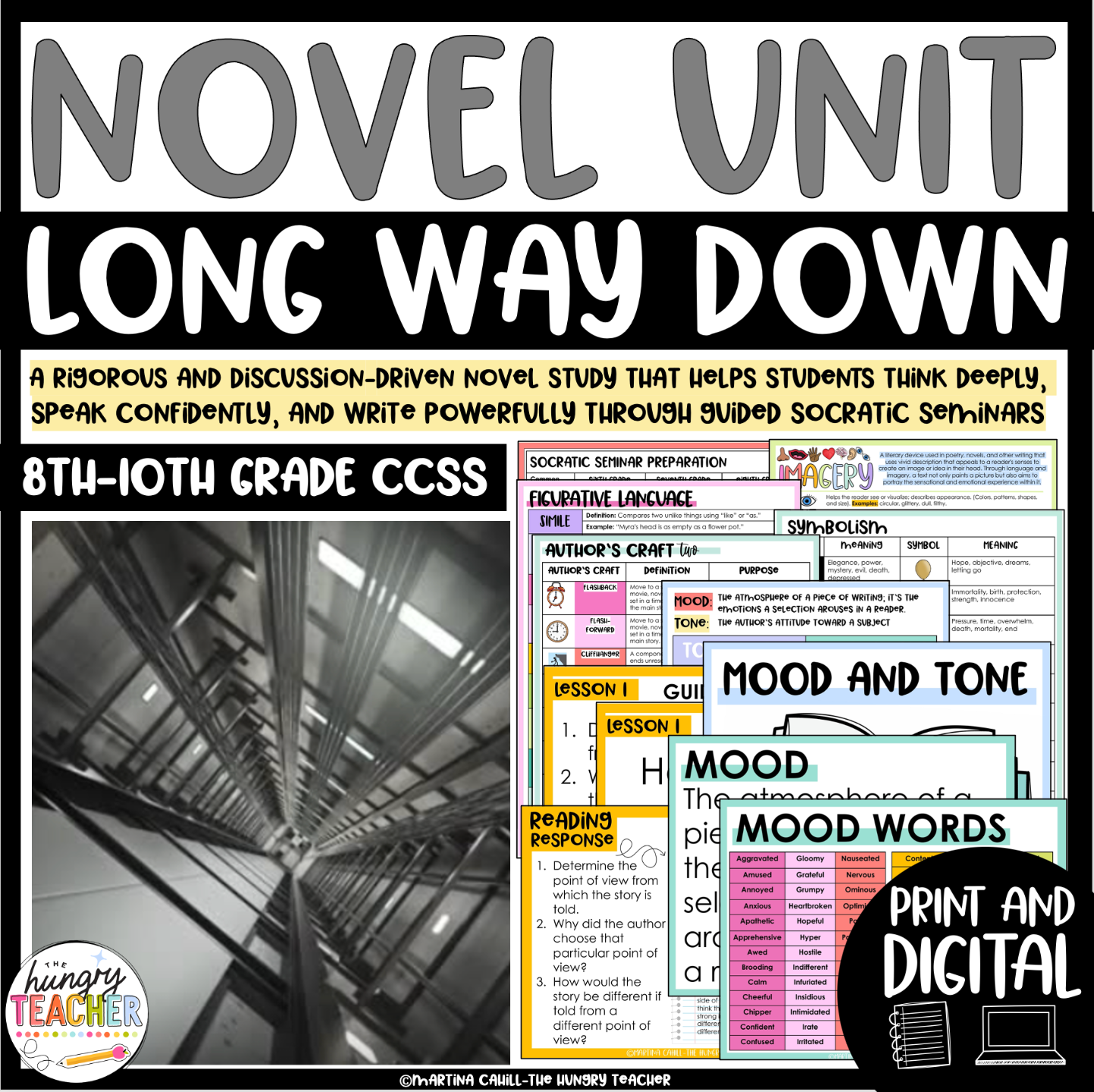
Long Way Down by Jason Reynolds

Students use guiding and interpretive questions to prepare their thinking, participate in structured Socratic Seminars, and then return to their writing to revise, expand, and strengthen their analysis. Instead of simply understanding what happens during Will’s elevator ride, students analyze how Jason Reynolds uses language, structure, characterization, and author’s craft to develop the novel’s larger ideas.
What makes this unit different:
- Instead of assigning dozens of comprehension questions, students focus on one strong question at a time—which leads to deeper discussions, stronger analytical writing, and more meaningful thinking about the novel.
- You’re not just “getting through the novel.” You’re teaching students how to think about literature—and how Reynolds uses the unique structure of a verse novel to create meaning.
What’s included:
- 10 structured, step-by-step lessons with pacing and teaching support
- Ready-to-teach slides for every lesson
- Guiding + interpretive discussion questions that build deeper thinking
- Digital + printable student notebooks and reading response pages
- Reading response organizers and example responses to model strong analytical writing
- Literary analysis reference pages and interactive notebook materials
- Editable reading response rubrics and response tools
- Socratic Seminar implementation support with norms, pacing, and classroom routines
- Literary analysis lessons covering point of view, characterization, figurative language, mood and tone, symbolism, conflict, and theme
- Bonus lessons for comparing texts and writing objective summaries
- Final project choice board with 10 creative and analytical options
- Print + digital formats for flexible classroom use
Students build their understanding through discussion, and that growth carries directly into their writing. The unit is designed primarily for 9th grade, but also works well for 8th grade and advanced 7th-grade readers, depending on your students and your school’s expectations for the novel.
The 10 lessons are:
- Pre-Lesson: Socratic Seminar Norms
- Long Way Down Day 1: Point of View
- Long Way Down Day 2: Character Traits
- Long Way Down Day 3: Figurative Language
- Long Way Down Day 4: Mood and Tone
- Long Way Down Day 5: Symbolism
- Long Way Down Day 6: Literary Conflict
- Long Way Down Day 7: Theme
- Long Way Down Day 8: Comparing Texts
- Long Way Down Day 9: Objective Summaries
- Long Way Down Day 10: Final Project
In this unit, students participate in meaningful discussions, strengthen their analytical writing, analyze the craft and structure of a verse novel, and wrestle with complex ideas about grief, loyalty, revenge, the Rules, choices, and the cycle of violence. At the same time, the consistent lesson structure gives students support as the literary analysis becomes increasingly complex.
The culminating project gives students 10 different ways to demonstrate their understanding, including analyzing the Rules, mapping Will’s elevator ride, examining symbolism, creating a verse-novel author’s craft portfolio, exploring character connections, and developing an evidence-based argument about what Will might do when the elevator doors open.
Prep is quick and manageable. Review the lesson materials and guiding questions, print or display the student resources, and follow the consistent read → write → discuss → revise routine. Students do more than answer questions about what happened—they use discussion and writing to analyze how and why Reynolds tells Will’s story the way he does.
TEACHERS LIKE YOU SAID…
⭐️⭐️⭐️⭐️⭐️ Amy S. says, "OBSESSED!!!! I am teaching summer school and I'm normally a math teacher but I am also teaching them ELA. I found this and I honestly wish I taught ELA so I could buy the rest of the novel studies and do them! This is the way you should teach ELA. Easily able to teach all standards through reading notebook, vocabulary, discussion. Lesson plans are soooo thorough. I highly suggest all upper elementary ELA teachers look into your resources!"
⭐️⭐️⭐️⭐️⭐️ Sarah V. says, "I really appreciate how this unit is organized and how thought provoking it has been. We are only a few days in and the students are loving the socratic seminar setup and I, being a newbie with this type of discussion setup, am enjoying all of the instructions and lack of busywork for students to just get done. I'll be purchasing more for the novels that I teach!
⭐️⭐️⭐️⭐️⭐️ Krista L. says, "Students are thrilled to be talking about the book instead of doing a ton of comprehension questions. My students’ writing improved because they are hyper focused on answering the discussion question and are actually using textual evidence to answer, because instead of 5-10 questions, they have one. The vocabulary and extra comprehension questions are very useful as well.